


Making the right design choice for cost, performance, and manufacturability
One of the key decisions in plastic part design is whether to consolidate multiple features into a single moulded component, or to split the design into separate parts that will be assembled later. Both approaches have advantages, and the right choice depends on functionality, cost, and production efficiency.
At CJ Tool & Mouldings, we work with design engineers and product developers to evaluate these options early in the design stage. With in-house moulding, assembly, and finishing capabilities, we can advise on the most practical and cost-effective route to achieve the required performance.
The Case for Part Consolidation
Consolidation involves combining multiple functions or features into a single injection moulded component. Advances in tooling and moulding technology now allow for increasingly complex geometries, making this a viable option in many designs.
Benefits of part consolidation:
- Reduced Assembly: Fewer components mean less assembly time and lower labour costs.
- Improved Strength: Eliminating joints, fasteners, or adhesives can improve durability and reliability.
- Simplified Supply Chain: Fewer components reduce sourcing and logistics requirements.
- Lower Tolerance Stack-Up: One moulded component avoids cumulative dimensional variation between parts.
Design considerations:
- More complex parts may require advanced tooling, such as slides or lifters, increasing tool cost.
- Moulding cycle times may increase if the part is large or intricate.
- Design changes may be more costly once tooling has been manufactured.
The Case for Assembly
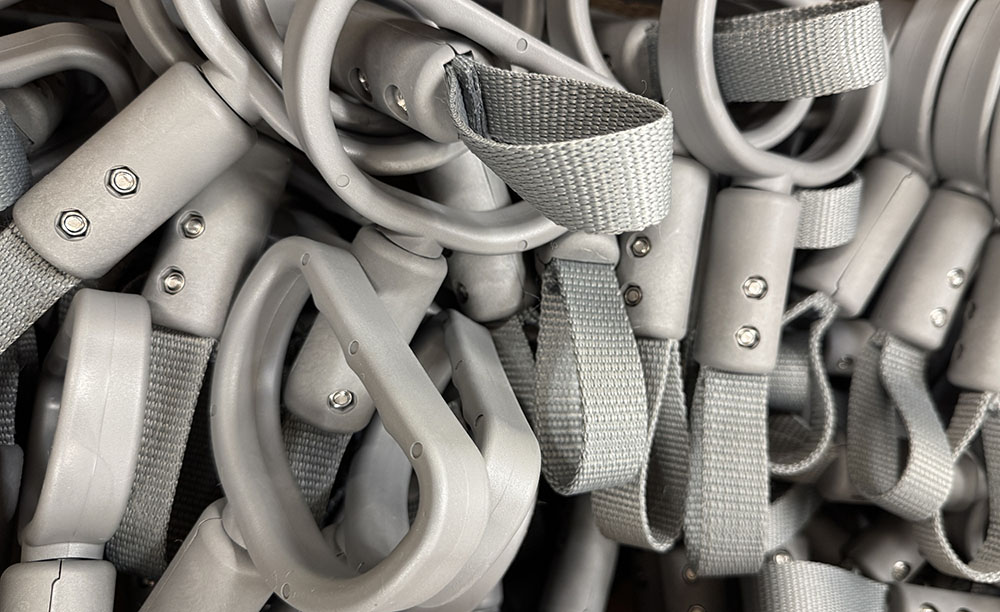
In some cases, splitting a product into multiple parts that are assembled after moulding is the better choice.
Benefits of assembly:
- Design Flexibility: Easier to change or replace individual components without redesigning the entire part.
- Material Optimisation: Different parts can be moulded in different materials to suit their specific functions.
- Simpler Tooling: Each tool may be less complex, lowering upfront tooling investment.
- Scalability: Parts can be moulded and stocked separately, then assembled as needed.
Design considerations:
- Additional labour or automation is required for assembly.
- Fasteners, adhesives, or welding processes may add cost.
- Joints and connections can become weak points if not designed correctly.
Balancing Consolidation and Assembly
The decision is rarely black and white. Often the optimal solution is a balance, consolidating features where it reduces cost and improves performance, while keeping separate parts where flexibility or simplicity is beneficial.
For example, a housing might be consolidated into a single moulding to improve strength, while smaller internal features may be designed as separate components to allow material variation or ease of replacement.
Partnering with CJ on Design Decisions
With both moulding and assembly capabilities in-house, CJ Tool & Mouldings is uniquely positioned to advise on part consolidation versus assembly. We work with design engineers to model costs, assess tooling requirements, and review production efficiency, helping to identify the approach that best supports the project.
By considering these factors early, you can reduce costs, simplify manufacturing, and deliver a product that performs as intended, from concept to component.